Magnifica Humanitas: Faith, Humanity, and Artificial Intelligence in a Digital Age
In Magnifica Humanitas, Pope Leo XIV offers a powerful reflection on how Christians and society should respond to Artificial Intelligence (AI), robotics, and rapid technological development. While acknowledging the benefits of modern technology, the central message is clear: technology must always serve the human person, never replace or diminish human dignity.
As AI becomes more advanced and integrated into daily life, the Pope raises an urgent question for the world: Are we building a future that still remembers what it means to be human?
Technology is Good, But the Human Person is Greater
The document begins with a strong foundation: technology is not evil. In fact, it can be a gift that improves life, supports development, and solves complex problems. However, it becomes dangerous when it begins to redefine human value.
The Pope warns against a growing tendency to treat human beings like machines, reducing people to data, productivity, or efficiency. In contrast, Christian teaching insists that every person has infinite dignity because they are created in the image and likeness of God.
No algorithm, system, or machine can replace that truth.
Babel or Nehemiah: Two Ways of Building the Future
To explain today’s technological world, the Pope draws from two biblical images.
The Tower of Babel
The story of Babel represents a society driven by pride and self-sufficiency, where humanity attempts to “reach the heavens” without God. In the context of modern technology, this reflects:
- Systems driven by power and control
- Technology that ignores moral boundaries
- Over-reliance on efficiency over ethics
- The risk of uniform thinking shaped by machines and systems
The warning is clear: when progress forgets God and humanity, it leads to confusion and fragmentation.
Nehemiah Rebuilding Jerusalem
In contrast, Nehemiah represents a community rebuilding together with purpose, faith, and cooperation. This vision reflects:
- Collaboration and inclusion
- Respect for human voices
- Technology used as a tool for service
- Progress rooted in faith and moral responsibility
The Pope presents this as the model for a truly human future: one where development strengthens community rather than replaces it.
Human Dignity: The Foundation of All Progress
At the heart of Magnifica Humanitas is a simple but profound truth: human dignity is not earned—it is given by God.
A person’s value does not depend on:
- Intelligence
- Productivity
- Wealth
- Social status
Instead, dignity is inherent and unchanging.
This means that every person matters equally; the elderly, the unemployed, the disabled, the poor, and the vulnerable all carry the same sacred worth.
Even if machines outperform humans in certain tasks, they can never surpass human dignity.
AI Cannot Replace What Makes Us Human
The document strongly rejects the idea that humanity can be replaced or “upgraded” through technology alone. It challenges ideologies such as transhumanism and posthumanism, which suggest that human limits should be eliminated through machines or biological enhancement.
The Pope emphasizes that what makes us truly human cannot be engineered. Machines may compute, predict, and automate, but they cannot:
- Love
- Forgive
- Show mercy
- Build authentic relationships
- Experience faith or grace
Human greatness is found not in perfection, but in love and relationships.
Truth, Work, and Freedom in the Digital Era
Truth
AI has the ability to generate realistic but false information, including deepfakes and manipulated content. This creates a serious challenge for truth in society.
The response required includes:
- Education in media literacy
- Responsible use of communication tools
- Awareness of misinformation
Without these, society risks losing its ability to distinguish truth from falsehood.
Work
Automation may transform or replace many forms of labour. While this can improve efficiency, it also raises concerns about unemployment and inequality.
The Pope insists that:
- Workers must never be treated as disposable
- Economic systems must prioritize human dignity
- Technology should support human work, not erase it
Freedom
Digital systems can track behavior, influence decisions, and shape opinions through algorithms. Over time, this can limit human freedom in subtle ways.
The warning is against becoming:
- Over-dependent on technology
- Manipulated by unseen digital systems
- Controlled by algorithmic influence
True freedom requires awareness, responsibility, and ethical safeguards.
A Choice Between Two Civilizations
The document presents two possible futures for humanity.
A Culture of Power
A world shaped by:
- Greed and control
- AI-driven warfare
- Surveillance and manipulation
- Loss of moral direction
A Civilization of Love
A world grounded in:
- Justice and peace
- Compassion and solidarity
- Respect for human dignity
- Global cooperation
The Pope strongly warns against the development of autonomous weapons and any form of AI that removes human moral responsibility from decisions of life and death.
Christ at the Center of Human Progress
The conclusion of Magnifica Humanitas is deeply Christ-centered.
By becoming human, Jesus affirms the sacred value of human life. God did not become a machine or an abstract intelligence—He became fully human. This reveals that human existence is not accidental, but profoundly meaningful.
Mary, through her Magnificat, is presented as a model of humility, faith, and hope in a changing world.
Conclusion: Building a Human Future
The final challenge of the document is both simple and urgent:
Do not build a future shaped only by pride, power, or technological advancement.
Instead, build a world where:
- Human dignity is protected
- Love guides innovation
- Justice shapes progress
- God remains at the center of society
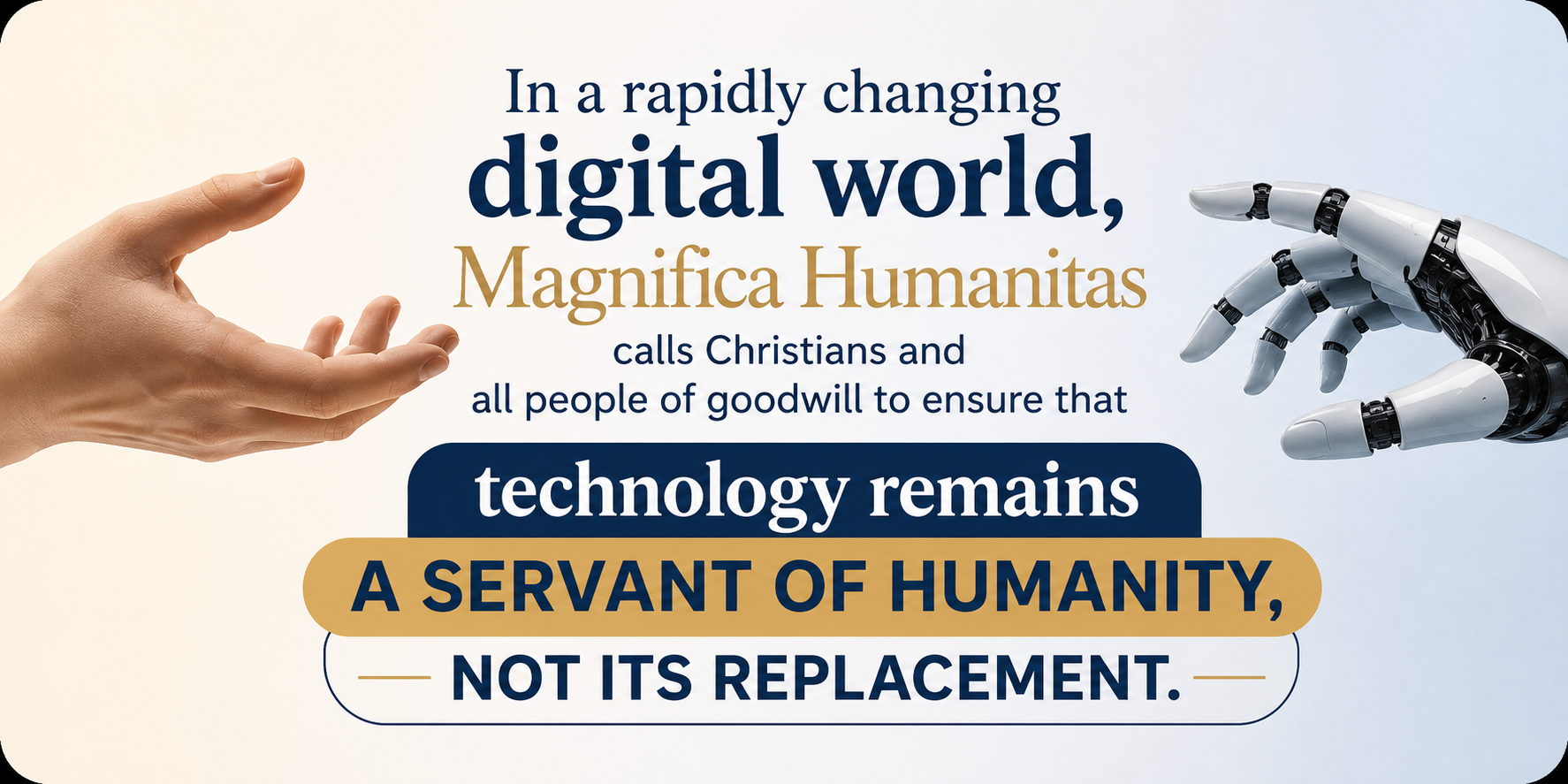
In a rapidly changing digital world, Magnifica Humanitas calls Christians and all people of goodwill to ensure that technology remains a servant of humanity, not its replacement.